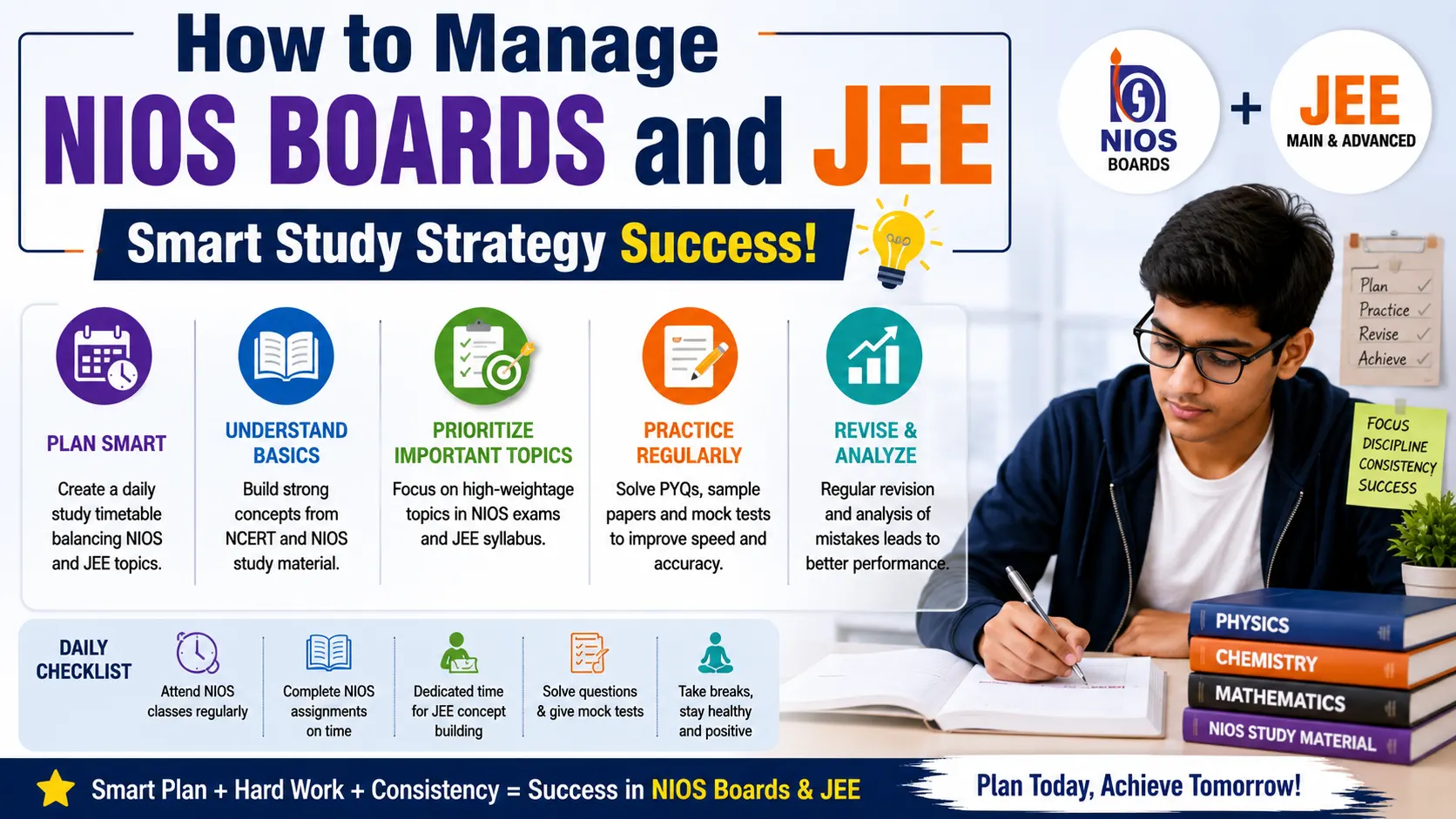
Managing Boards and JEE together requires a clear understanding of how both exams are connected and how to balance preparation effectively. With the right approach, students can save time and improve performance in both.
- Know the syllabus overlap between Boards and JEE
Focus on topics that are common in both exams, especially in Physics, Chemistry, and Maths, to reduce extra effort.
- Identify common topics (Physics, Chemistry, Maths)
Prioritize chapters like Mechanics, Organic Chemistry, and Algebra which are important for both Board exams and JEE.
- Create a balanced mindset for both exams
Avoid treating them separately; instead, prepare with a combined strategy that supports conceptual clarity and exam-oriented practice.
1. How to manage school and jee preparation
Managing school and JEE preparation together requires a smart and balanced approach. Students should focus on building strong concepts from school subjects while also practicing JEE-level questions. Understanding the syllabus overlap helps in saving time and makes preparation more effective.
A proper routine is important in How to Manage School and JEE Preparation, where school studies and JEE practice are given equal priority. Students should attend school regularly and use extra time for concept revision and problem-solving. Morning or evening study slots can be dedicated to JEE preparation while keeping school homework consistent.
Regular practice and revision are the key to success in How to Manage Boards and JEE Preparation. Solving NCERT exercises, previous year questions, and mock tests improves speed, accuracy, and confidence. Staying consistent, disciplined, and stress-free ensures better performance in both school exams and JEE
Call For More Details
2. Time Table Based on How to Manage Boards and JEE Preparation
A well-planned timetable helps balance both Boards and JEE effectively without stress.
2.1 Divide Daily Study Hours
- Allocate fixed hours for Boards syllabus revision
- Set separate time for JEE problem-solving practice
- Maintain consistency every day
2.2 Morning for Concepts, Evening for Practice
- Morning: Study theory and clear concepts (NCERT + school topics)
- Evening: Solve JEE-level numerical questions
- Use night time for quick revision
2.3 Weekly Revision Plan for Both Exams
- Revise all subjects at least once a week
- Focus more on weak topics during revision
- Take mock tests or sample papers regularly
3. Smart Study Techniques for Dual Preparation
Effective preparation for Boards and JEE requires smart techniques that save time and improve understanding.
3.1 NCERT First, Then JEE-Level Questions
- Build strong fundamentals using NCERT books
- Clear concepts before moving to advanced problems
- Use JEE questions to apply and test knowledge
3.2 Make Short Notes and Formula Sheets
- Write key points in simple notes for quick revision
- Create formula sheets for Physics, Chemistry, and Maths
- Revise these regularly before exams
3.3 Practice Previous Year Papers Regularly
- Solve past JEE and board exam papers
- Improve speed, accuracy, and exam confidence
- Identify important topics and question patterns
Join NIOS
4. How to Manage Boards and JEE with Proper Revision Strategy
A proper revision strategy is very important in How to Manage Boards and JEE effectively. Students should follow a structured plan where they revise all subjects on a weekly and monthly basis. This helps in strengthening concepts and improving long-term memory of important topics.
It is also important in How to Manage Boards and JEE to focus on high-weightage and frequently asked topics from both exams. Practicing mock tests and previous year question papers regularly helps in understanding the exam pattern, improving speed, and increasing accuracy. This practice also builds confidence for the final exam.
Along with this, students should give extra attention to weak topics in How to Manage Boards and JEE to improve conceptual clarity. Consistency in following a fixed revision routine is the key to reducing stress and staying well-prepared. A disciplined approach ensures better performance in both Boards and JEE.
5. Stress-Free Approach to Success
Maintaining balance is important to stay productive and avoid burnout during preparation. A smart approach helps you perform better in both Boards and JEE.
5.1 Avoid Overloading Study Hours in How to Manage Boards and JEE
- Don’t study for long hours without a proper plan
- Focus on quality study instead of just increasing hours
- Set realistic and achievable daily targets
5.2 Take Short Breaks for Better Focus
- Take 5–10 minute breaks after each study session
- Refresh your mind to improve concentration and retention
- Avoid studying continuously for long hours
5.3 Stay Consistent Instead of Overworking
- Follow a fixed daily routine for steady progress
- Study regularly instead of last-minute cramming
- Consistency helps achieve better long-term results
6. Final Strategy for High Scores
A strong final approach helps you perform better in both Boards and JEE exams.
6.1 Balance Speed + Accuracy in How to Manage Boards and JEE
- Practice solving questions within time limits
- Avoid careless mistakes while increasing speed
- Maintain accuracy along with fast problem solving
6.2 Strengthen Conceptual Clarity
- Focus on understanding basic concepts deeply
- Revise NCERT and core fundamentals regularly
- Clear doubts immediately to avoid confusion
6.3 Stay Disciplined Till Exam Day
- Follow your daily study plan strictly
- Avoid distractions and stay consistent
- Keep revising until the final exam day