
Get in Touch
We will get back to you within 24 hours.
We will get back to you within 24 hours.
Welcome to MVS Blog

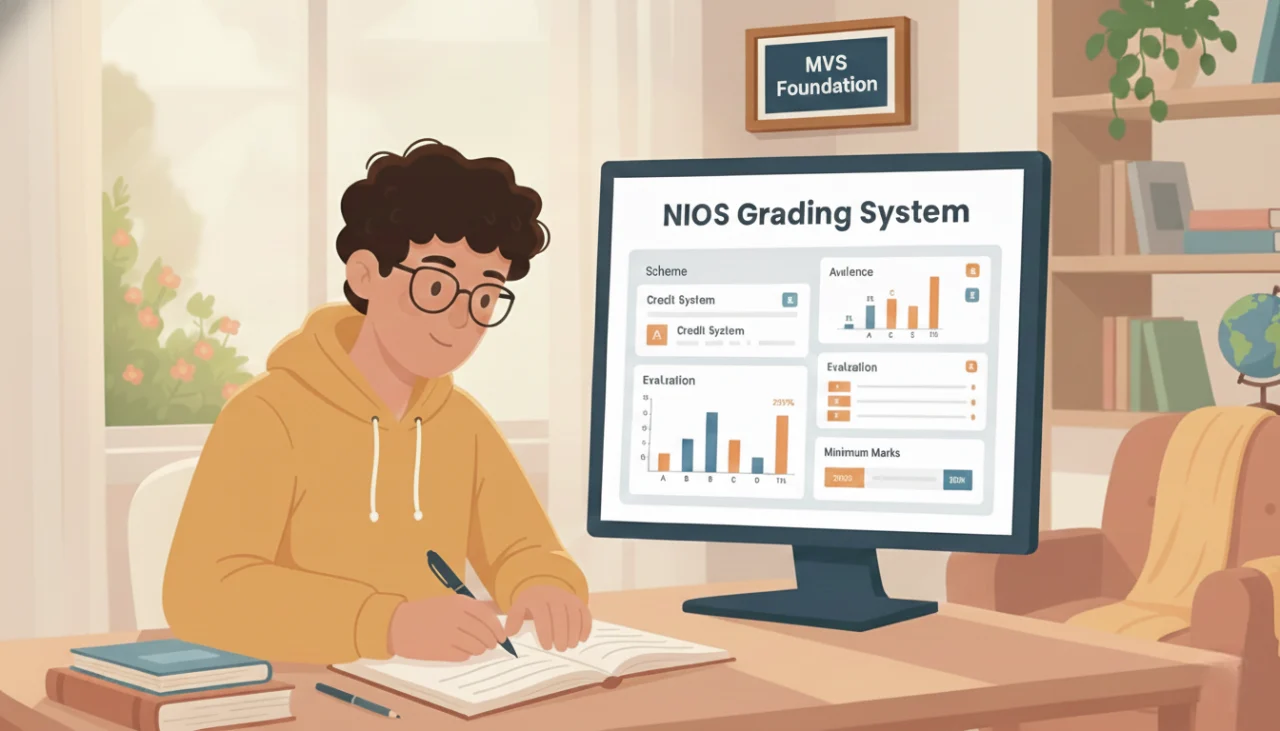
Navigating an educational board’s exam rules might feel tricky - NIOS works much the same way. Across India, learners doing Class 10 or Class 12 through open school need clear info on how marks are figured out. To make sense of your results, check the real NIOS grading scale. This tool turns your test numbers into letters, so you can easily see how you're doing in school. Here’s a simple look at how it works - how points become grades, also what exactly you must hit to pass the NIOS exams.

Instead of just looking at scores, NIOS goes broader - ending up with a 5-level grade mark from A to E. These levels help balance outcomes no matter the topic or how tough it was. The score you see on your report card comes from how well you did in:
Theory Exams: These are the key paper-based tests given when public exams happen.
Real-life tests: Doing tasks yourself in science or hands-on topics - like experiments instead of just reading.
Tutor Marked Assignments (TMAs): these are internal tests, making up 20% of your grade per subject.
The scores depend on how well the student does overall - the full mark added up from every part - for one class.
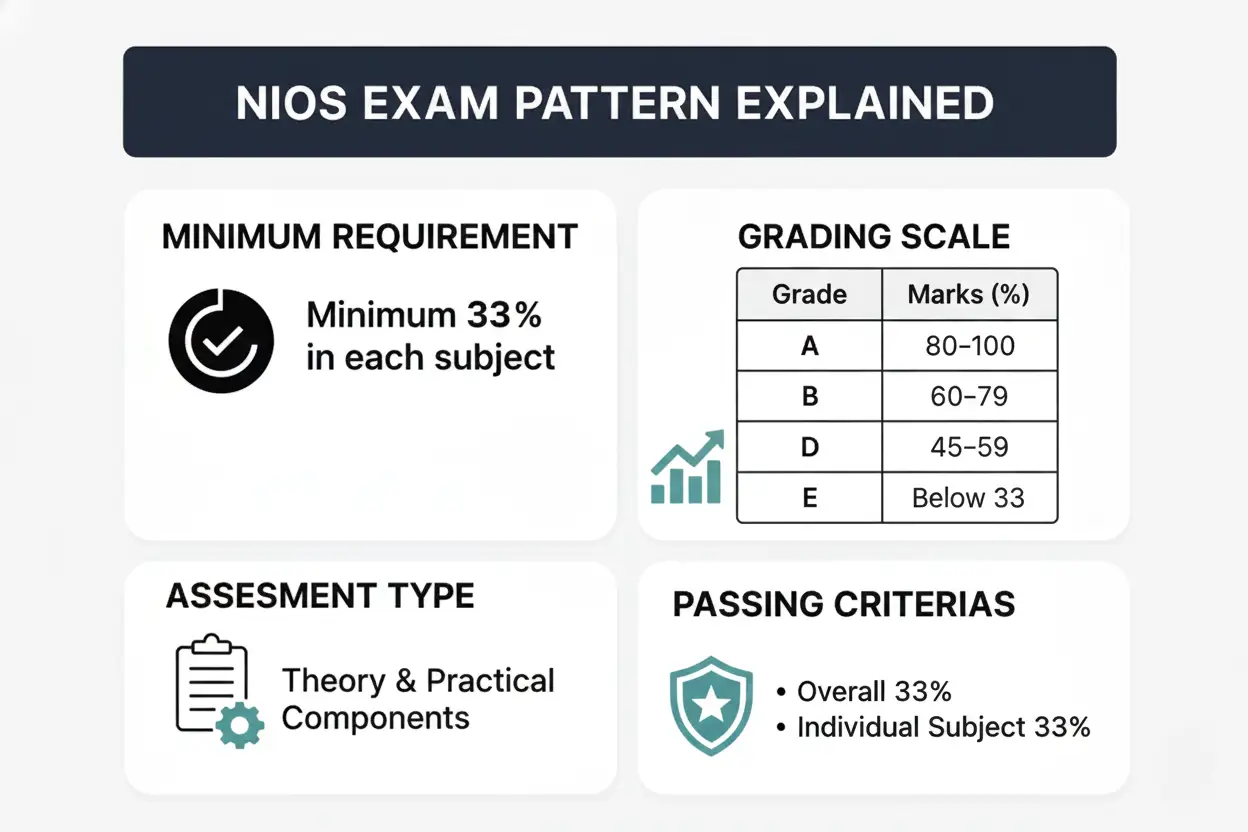
The official NIOS grade chart shows how percent scores turn into letter grades. Knowing this scale matters - getting a D means you pass, but an E tells you to retake the subject. That’s what counts when clearing the exam
Just getting a good score in one class isn't sufficient - hitting the total pass mark decided by the board matters more if you want your diploma. The basic idea’s clear - hit at least 33% overall to pass. On top of that, you’ve got to clear five subjects altogether. This is where the rules change a bit from 10th to 12th grade - something that often trips up students.
| Grade | Percentage Range | Grade Point | Interpretation |
|---|---|---|---|
| A | 80% and above | 10.0 | Outstanding/Excellent |
| B | 60% to 79% | 8.0 | Very Good/First Division |
| C | 40% to 59% | 6.0 | Good/Second Division |
| D | 33% to 39% | 4.0 | Satisfactory/Pass |
| E | Below 33% | 1.0 | Not Passed/Fail |
Students receive both a detailed mark sheet showing exact scores and a grade card that shows these letter grades. This dual reporting system offers complete transparency.
For Class 10 learners, NIOS grading makes judging easier a bit - especially when hands-on work’s involved. You need at least 33% when you add up all five subjects - make sure it hits the mark. Some topics - say, Home Science or Data Entry Work - mix written test marks with hands-on task results. These two parts get added up into one total per topic. To pass, your joint result must hit at least 33%. That’s what counts toward your final average.
The rules for Grade 12 are tougher - each part needs closer focus.
Put together: Once more, you need at least 33% across the five main subjects counted for your certificate. Here’s how it works - split scores matter.
For Class 12, you’ve got to hit at least 33% on both the written test and hands-on exam if your subject includes lab work, like Bio or Chem. Say you clear the theory part but bomb the practical - get an E grade - you don’t scrape through. You’ll need to retake just that portion next time.

Once you get your results, check for certain symbols showing where things stand - these marks explain what’s going on. Instead of letters or words, short forms point out your current situation clearly.
TMA (Tutor Marked Assignments) matter a lot when it comes to lifting your total grade. Each subject gives you up to 20 points from them. So while your theory test might go badly, solid TMA results still help cross the 33% minimum pass mark - shifting you from an E straight into a D or even a C.
P (Pass): Shows you made it through the class okay - so, job’s done.
NP means you didn't pass one part - or maybe more - of the test.
SYC (Subject Yet to Clear) means you’ve got a pending task in this particular course. It’s when something’s missing or unfinished there.
SYCP (Still Needs a Pass in Hands-On Work): For Grade 12 only - this shows you must retake just the lab or field portion. Instead of redoing everything, only that section counts now. It doesn't cover written tasks. So focus lands on doing better there next time around.
Sometimes called SYCT - this happens when you've got to retake just the written portion. It’s not about failing everything, only that section wasn't passed. Think of it like unfinished business on paper. So if results say this, plan for another go at the theory test. No lab or practical involved, just classroom-style stuff again.

If you end up with a Grade E in any subject, just try again - it’s that simple. What makes NIOS great? No need to sit around for twelve months; jump back in sooner. Some learners might wait till the upcoming test window - often in spring or late autumn - to try again. Otherwise, there’s a quick option through ODES, letting them retake the exam right away at set locations. Whichever score turns out higher gets kept on the official record. No duplicates show up, just the top one.
Please keep in mind - the NIOS grading setup, passing marks (at least 33%), along with particular rules (such as distinct passes for Class 12 theory and practicals), come from the National Institute of Open Schooling board; these might change when reviewed.
Even though what’s shared here matches how things usually work, actual rules or score details might shift since NIOS can tweak them anytime. So instead of guessing, learners should check the newest updates straight from the official NIOS site - especially right before exams - to stay fully up to date.
Contact us for Admission: 91 8882104776

The NIOS grading setup helps measure real understanding instead of just cramming facts. Hitting the 33% mark matters most, but pushing beyond it makes sense. Getting A or B grades can lead to college chances - many schools expect solid scores there. Figuring out these rules gets you started on smart prep. When you boost your TMA marks, train hard using past examples, also focus sharply on concepts along with hands-on needs, that way you’ll move through NIOS smoothly while doing well school-wise.
1 Response

Stay updated with the latest news, articles and updates directly into your box