Get in Touch
We will get back to you within 24 hours.
We will get back to you within 24 hours.
Welcome to MVS Blog
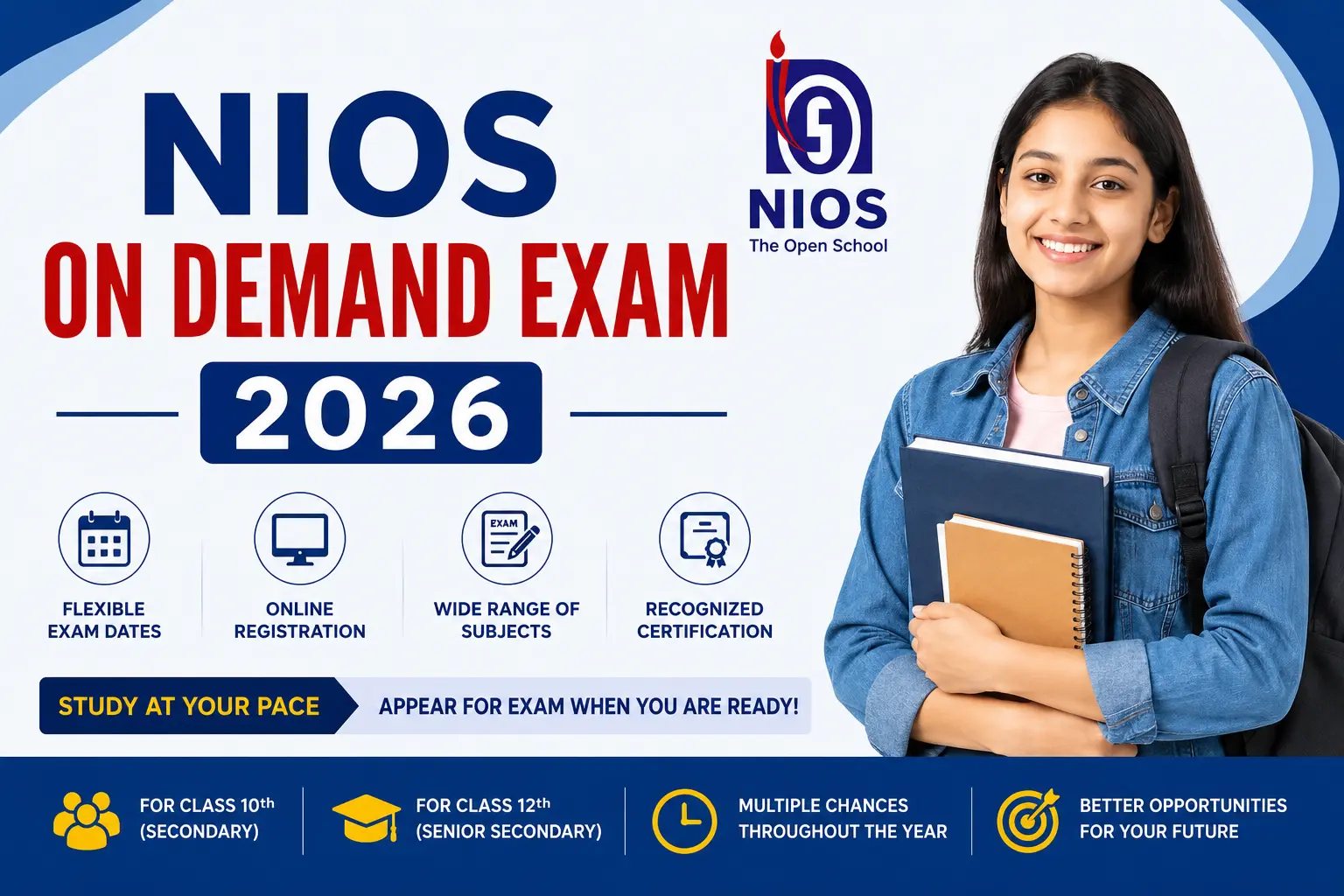
The NIOS On Demand Exam system is one of the most flexible examination options available for students in India. It is specially designed for learners who want to study at their own pace and appear for exams when they feel fully prepared. Unlike traditional board exams that are conducted only once or twice a year on fixed dates, the On Demand Examination system gives students the freedom to choose their exam date according to their preparation level. This makes the learning process less stressful and more student-friendly.
Many students prefer this option because it provides a second chance to continue their education without losing an academic year. Students who could not score well in regular board exams, faced personal difficulties, or needed extra preparation time often find this system very helpful. It is also beneficial for working students, athletes, artists, or learners who cannot follow a regular school schedule. The flexible structure allows students to focus on understanding concepts instead of studying under constant pressure.
Another major reason behind the popularity of the NIOS On Demand Exam is the freedom it offers in learning and examination. Students can prepare according to their own timetable and attempt exams only when they feel confident. This approach helps reduce fear and anxiety related to board examinations. It also motivates students to perform better because they are not forced to appear before they are ready.
The system plays an important role in helping students continue their education journey smoothly. Instead of dropping out after failure or low marks, students get an opportunity to improve their performance and achieve their academic goals. Since NIOS certification is recognized across India, students can also use it for higher education, competitive exams, and career opportunities. Overall, the On Demand Exam system provides flexibility, convenience, and confidence to students who need an alternative and supportive education system.
The On Demand Examination System is a unique and student-friendly concept introduced by NIOS to provide flexibility in education. Unlike regular board examinations, where students have to appear on fixed dates decided by the board, this system allows students to choose their exam date according to their own preparation level. This means students can appear for exams when they feel fully confident and ready, which helps reduce pressure and improves overall performance.
One of the biggest differences between the On Demand system and traditional board exams is flexibility. In regular school boards such as CBSE or other state boards, exams are usually conducted once a year and students must wait several months for another attempt if they fail or want to improve marks. However, in the On Demand system, students get multiple opportunities to appear for exams throughout the year. This saves valuable time and helps students continue their studies without unnecessary delays.
The flexible exam schedule is one of the main reasons why many students prefer this option. Students can plan their studies according to their personal schedule and book exams only when they are properly prepared. This is especially useful for students who are balancing education with work, sports, family responsibilities, or other activities. Instead of following a strict school timetable, learners can study at their own pace and focus more effectively on important subjects.
The system is also highly convenient because it gives students more control over their academic journey. They can select subjects, choose exam dates, and prepare in a way that suits their learning style. This flexibility helps reduce exam stress and creates a more comfortable learning environment.
The On Demand Examination System is ideal for several types of students. It is a good option for students who failed in regular board exams and want another chance without wasting a year. It is also suitable for students who wish to improve their marks, school dropouts who want to continue their education, working professionals, and learners who require a flexible study pattern. Overall, the system provides a practical and supportive alternative for students looking for a stress-free and flexible education path.
Before applying for the NIOS On Demand Examination, students must carefully check the eligibility criteria for their chosen course. The National Institute of Open Schooling( nios.ac.in ) has set specific rules regarding age limits and educational qualifications for both Class 10 and Class 12 students. Understanding these requirements is important because incorrect eligibility details can lead to application rejection during the admission or examination process.
For students applying to the Secondary Course (Class 10), the minimum age requirement is generally 14 years. Applicants should have basic educational knowledge suitable for secondary-level studies. Students who could not continue regular schooling, failed in another board, or want a flexible education system can apply for this course through NIOS. The system is designed to support students from different educational backgrounds and provide them with an alternative path to complete their schooling.
For the Senior Secondary Course (Class 12), students must have already passed Class 10 or an equivalent examination from a recognized board. The minimum age requirement for Class 12 admission is usually 15 years. Students who wish to continue higher studies, improve their academic performance, or complete their education through an open learning system can apply for the senior secondary program. Having valid Class 10 documents is necessary during the registration process.
Apart from age and qualification requirements, students should also ensure that all personal details and documents are correct while applying. Educational certificates, identity proof, photographs, and other required documents must be uploaded properly to avoid delays or rejection. Students are advised to read all official guidelines carefully before submitting their application form.
The eligibility criteria are created to ensure that students apply for the correct level according to their educational background and age. Once students meet these conditions, they can take advantage of the flexible examination system offered by NIOS and continue their studies without unnecessary academic pressure.

Applying for the NIOS On Demand Examination is a simple online process, but students must fill out the application form carefully to avoid mistakes. The registration process is designed to make admissions convenient for students across India. By following the correct steps and uploading the required documents properly, students can complete their application smoothly without any difficulty.
The first step in the online application process is visiting the official NIOS admission portal and selecting the appropriate course, either Secondary (Class 10) or Senior Secondary (Class 12). After choosing the course, students need to create their account and enter basic details such as name, date of birth, mobile number, email ID, and address. Once the registration is completed, applicants can proceed to fill in their educational qualifications and subject preferences.
After entering personal and academic details, students are required to upload important documents. These usually include a recent passport-size photograph, signature, identity proof, address proof, and previous educational certificates. Class 10 applicants may need basic educational proof, while Class 12 students must upload their Class 10 marksheet or certificate from a recognized board. All documents should be scanned clearly and uploaded in the correct format and file size mentioned on the portal.
Students should also carefully select their subjects while filling out the form because incorrect subject choices can create problems later during examinations. Before making the final payment, applicants must review every detail entered in the form, including spelling of names, date of birth, contact information, and uploaded documents. Even small mistakes can lead to delays or rejection during verification.
Once all details are verified, students can pay the registration and examination fees through the available online payment methods. After successful payment, it is important to download and save the confirmation receipt and application form for future reference. Students are also advised to regularly check updates related to exam schedules, hall tickets, and official announcements after completing their registration.
By carefully following the online application process and checking all details before submission, students can avoid common mistakes and complete their NIOS admission process smoothly and successfully.
The fee structure for the NIOS On Demand Examination is designed to be affordable and accessible for students from different educational backgrounds. Before applying, students should understand the complete fee details, including subject-wise examination charges, practical subject fees, and the payment process. Knowing the fee structure in advance helps students avoid confusion during registration and ensures a smooth application experience.
NIOS generally charges examination fees on a per-subject basis. This means students only need to pay for the subjects they choose for the examination. The fee amount may vary depending on whether the subject is theoretical, practical, or vocational. Students appearing for more subjects will have a higher total fee, while those choosing fewer subjects will pay accordingly. It is always important to check the latest fee details on the official portal before submitting the application because fee structures can change over time.
For subjects that include practical examinations, students may need to pay additional practical fees separately. Science, computer-related subjects, and some vocational courses usually include practical components. These charges cover laboratory work, practical examinations, and other related activities. Students should carefully review which subjects contain practical exams so they can calculate their total fees correctly before making payment.
NIOS provides multiple online payment options to make the process simple and convenient for students. Applicants can usually pay through debit cards, credit cards, net banking, UPI, and other digital payment methods available on the portal. After successful payment, students receive a payment confirmation and registration receipt. It is very important to download and save this confirmation for future reference because it may be required during examination or verification processes.
Before completing the payment, students should carefully recheck all details entered in the application form, including selected subjects and uploaded documents. Once the payment is successfully submitted, making corrections can become difficult. Therefore, reviewing every detail beforehand can help students avoid unnecessary issues later.
Overall, the NIOS fee system is structured to provide flexibility and convenience while keeping education affordable for students who want to continue their studies through the On Demand Examination system.
The NIOS On Demand Examination process is designed to give students maximum flexibility and convenience. Unlike traditional board exams that follow fixed schedules, the On Demand system allows students to choose when they want to appear for their exams. This flexible approach helps students prepare according to their own pace and appear only when they feel confident about their preparation.
To book an examination, students need to log in to the official NIOS student portal using their enrollment details. After logging in, they can select the subjects in which they want to appear and choose the available exam date and examination center according to seat availability. The booking process is fully online, making it simple and convenient for students from different locations. However, students should book their exams early because seats at preferred centers may fill quickly.
NIOS offers a wide range of subjects for both Secondary (Class 10) and Senior Secondary (Class 12) students. These include language subjects, science, mathematics, social science, commerce, humanities, and vocational courses. Subject availability may differ depending on the examination center and schedule. Exam dates are available throughout the year under the On Demand system, which gives students multiple opportunities to attempt their exams without waiting for annual board examinations.
Once the exam booking is confirmed, students can download their admit card or hall ticket from the official portal before the examination date. The admit card contains important details such as the student’s name, roll number, subject name, examination date, reporting time, and exam center address. Students must carefully check all information mentioned on the admit card and carry a printed copy to the examination center along with a valid identity proof.
After the examination is completed, NIOS usually declares results within a few weeks. Students can check their results online by entering their enrollment number on the official website. The marksheet and certificate are issued after the result declaration and can be downloaded or collected according to NIOS guidelines. Since the On Demand system provides quicker result processing compared to many regular boards, students can continue their higher studies or career planning without long waiting periods.
Overall, the exam process is simple, flexible, and student-friendly, making it easier for learners to manage their studies and examinations in a stress-free manner.
NIOS provides a wide variety of subjects for both Secondary (Class 10) and Senior Secondary (Class 12) students. The flexible subject selection system allows students to choose subjects according to their interests, career goals, and educational background. This is one of the major advantages of the NIOS On Demand Examination system because students are not limited to a fixed stream or rigid subject combination.
At the Secondary level (Class 10), students can choose from many popular subjects such as Mathematics, Science, Social Science, English, Hindi, Home Science, and Business Studies. These subjects are designed to provide students with a strong academic foundation while maintaining flexibility in learning. Students can select subjects based on their comfort level and future educational plans.
For the Senior Secondary level (Class 12), NIOS offers subjects from different streams including Science, Commerce, and Humanities. Popular subjects include Physics, Chemistry, Biology, Mathematics, Accountancy, Economics, Political Science, History, Geography, Sociology, and Psychology. Students can combine subjects from different streams according to their interests, which is not always possible in regular school boards. This flexibility helps students create a personalized learning path that matches their future career goals.
NIOS also offers several language subjects to support students from different regions and educational backgrounds. Common language options include English, Hindi, Sanskrit, Urdu, Punjabi, Bengali, and many other regional languages. Language subjects help students improve communication skills and complete mandatory educational requirements.
In addition to academic subjects, NIOS provides vocational and skill-based courses that focus on practical learning and career development. These vocational subjects are useful for students who want to gain professional skills alongside their education. Courses related to computer applications, business skills, health care, hospitality, and other industries are available in the vocational category. Such subjects help students prepare for employment opportunities and practical career paths after completing their studies.
Overall, the wide range of academic, language, and vocational subjects offered by NIOS gives students the freedom to choose an education path that suits their personal interests and future ambitions.
One of the biggest advantages of the NIOS On Demand Examination system is the freedom it gives students to choose their exam dates according to their preparation level. Unlike regular board exams that are conducted on fixed schedules, NIOS allows students to appear for exams when they feel fully ready. This flexibility reduces exam pressure and helps students perform with greater confidence. Students can plan their studies more effectively and avoid the stress of rushing through preparation.
Another major benefit is the opportunity to improve marks quickly without waiting for an entire academic year. In traditional boards, students who fail or want better marks usually have to wait several months for compartment or improvement exams. However, the On Demand system gives students multiple chances throughout the year. This helps students save time and continue their education without unnecessary delays. It is especially beneficial for students preparing for college admissions, competitive exams, or career opportunities where timely results are important.
The flexible learning system is also highly helpful for students with different lifestyles and responsibilities. Students who are working, preparing for sports competitions, managing family responsibilities, or facing personal challenges can continue their education at their own pace. Since the system does not force students to follow a strict school routine, learners get more control over their study schedule and learning process. This makes education more accessible and comfortable for many students who struggle in traditional classroom environments.
Another important advantage of NIOS is that its certification is recognized across India for higher education and employment opportunities. Students who complete their Secondary or Senior Secondary education through NIOS can apply for colleges, universities, competitive examinations, and government or private jobs just like students from other recognized boards. The recognition and validity of the certificate give students confidence that their education will support their future academic and professional goals.
Overall, the NIOS On Demand Examination system provides flexibility, convenience, faster improvement opportunities, and recognized certification, making it an excellent option for students looking for an alternative and student-friendly education system.
While applying for the NIOS On Demand Examination, students should be very careful during the registration process because small mistakes can create major problems later. Many applications face delays or rejection due to incorrect information, incomplete documents, or wrong subject selection. By understanding the common mistakes in advance, students can complete their application process smoothly and avoid unnecessary stress.
One of the most common mistakes is uploading incorrect or unclear documents. Students sometimes upload blurred photographs, invalid certificates, wrong file formats, or incomplete documents during registration. This can lead to verification issues and may even result in rejection of the application. Before uploading, students should ensure that all documents are clearly scanned, properly visible, and uploaded according to the required size and format mentioned on the official portal.
Another important mistake students often make is selecting the wrong subjects. Since NIOS provides flexibility in choosing subjects, students should carefully select subjects based on their educational goals, interests, and eligibility requirements. Choosing subjects without proper planning can create difficulties later, especially for students preparing for college admissions or competitive exams. It is always better to review subject combinations carefully before final submission because changes after registration may not be easy.
Ignoring eligibility rules is also a serious issue that many students face. Some students apply without checking the minimum age criteria or educational qualification requirements for Secondary and Senior Secondary courses. If a student does not meet the eligibility conditions, the application can be rejected during verification. Therefore, students should carefully read all official guidelines and ensure they meet every requirement before applying.
Another common problem is waiting until the last date to complete the application process. Many students delay registration and face technical issues, payment failures, website traffic problems, or incomplete documentation at the final moment. Applying early gives students enough time to correct mistakes, upload proper documents, and complete payment without pressure. Early registration also helps students get better exam date and center availability.
By avoiding these common mistakes, students can complete their NIOS admission and examination process more confidently and without unnecessary complications. Careful planning and proper attention during registration can save both time and effort in the future.
Proper preparation plays an important role in achieving good marks in the NIOS On Demand Examination. Since the system gives students the flexibility to appear for exams when they feel ready, students should use this advantage wisely and prepare with a clear study plan. Consistent practice, smart learning strategies, and disciplined time management can help students perform confidently in their exams.
One of the best ways to prepare for NIOS exams is by studying through NCERT books. Most of the questions in NIOS examinations are based on concepts similar to NCERT-level content, especially for subjects like Science, Mathematics, Social Science, and languages. NCERT books explain topics in simple language and help students build strong basic understanding. Students should carefully read each chapter, understand key concepts, and revise important points regularly.
Practicing sample papers and previous year questions is another effective preparation method. Regular practice helps students understand the exam pattern, question style, marking scheme, and important topics. Solving sample papers also improves speed and accuracy, which increases confidence before the actual examination. Students should try to solve papers within a fixed time limit to improve time management skills during exams.
Students should also focus more on important chapters and high-weightage topics instead of trying to memorize everything at once. Identifying frequently asked topics and understanding core concepts can help students prepare more effectively. Making short notes, highlighting important formulas, and revising key points regularly can make revision easier before exams.
Creating a proper study timetable is equally important for successful preparation. A well-planned timetable helps students manage their time efficiently and maintain consistency in studies. Students should divide their time between reading, revision, practice questions, and mock tests. It is also important to include short breaks and realistic daily goals in the schedule to avoid stress and burnout.
By following a disciplined study routine, using the right study materials, and practicing regularly, students can prepare effectively for the NIOS On Demand Examination and improve their chances of scoring better marks with confidence.
Many students and parents have common questions regarding the NIOS On Demand Examination system before applying. Understanding these important details can help students make better decisions about their education and examination process. Below are some of the most frequently asked questions related to NIOS admissions, exam validity, subject selection, and result processing.
Yes, students who failed in regular board examinations can apply for the NIOS On Demand Examination system. This is one of the main reasons why many students choose NIOS. It provides another opportunity to continue education without wasting an academic year. Students can prepare again and appear for exams according to their own readiness and confidence level.
Yes, the NIOS certificate is recognized by many colleges, universities, and educational institutions across India. Students who complete their Secondary or Senior Secondary education through NIOS can apply for higher studies, competitive examinations, and various government or private sector opportunities. Since NIOS is a recognized open schooling board, its certification holds educational value similar to other recognized boards.
Yes, students can appear for multiple subjects through the On Demand Examination system. They can choose subjects according to their educational needs and career goals. The flexibility of subject selection allows students to improve marks, complete pending subjects, or study combinations that suit their future plans. However, students should carefully check subject availability and eligibility rules before selecting their subjects.
The result process in the NIOS On Demand Examination system is usually faster compared to many traditional board examinations. Results are generally declared within a few weeks after the examination, depending on the subject and examination schedule. Students can check their results online through the official portal using their enrollment details. After the result declaration, marksheets and certificates are issued according to NIOS guidelines.
These frequently asked questions help students better understand the flexibility, recognition, and convenience offered by the NIOS On Demand Examination system. Students should always stay updated with official notifications and guidelines before applying or booking their examinations.
The NIOS On Demand Examination system is an excellent opportunity for students who want flexibility, multiple chances to improve, and a stress-free learning environment. Whether a student wants to complete their education after a gap, improve marks, or continue studies through an alternative system, NIOS provides a convenient and recognized platform for academic growth. Its flexible exam schedule and student-friendly approach make it a popular choice among learners across India.
Students planning to apply should carefully understand the eligibility criteria, subject selection process, fee structure, and examination guidelines before completing their registration. Proper planning and accurate document submission can help avoid unnecessary problems during admission and examination procedures. Choosing the right subjects and preparing with a clear study strategy can also improve overall performance in exams.
It is very important for students to regularly check official notifications and updates related to admissions, exam booking, hall tickets, results, and other important announcements. Staying updated helps students avoid missing deadlines and ensures they follow the latest guidelines issued by NIOS.
Students are also encouraged to begin their preparation early instead of waiting until the last moment. Studying consistently, practicing sample papers, and following a proper timetable can build confidence and improve results. Applying on time and preparing seriously can help students make the best use of the flexible opportunities provided by the NIOS On Demand Examination system and move forward confidently toward their academic and career goals.
0 Response

Stay updated with the latest news, articles and updates directly into your box