Get in Touch
We will get back to you within 24 hours.
We will get back to you within 24 hours.
Welcome to MVS Blog
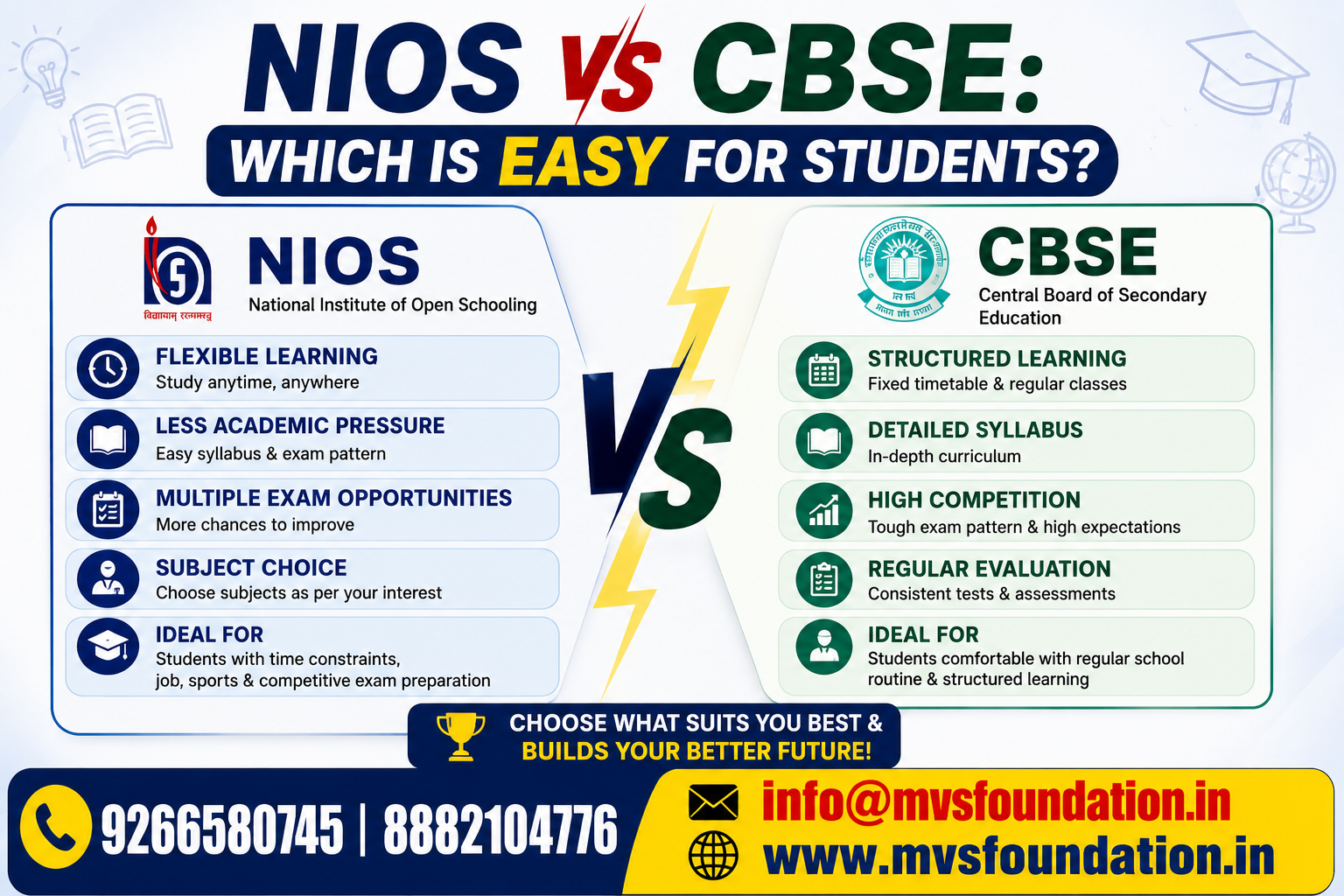
When students look for flexible and stress-free education options, the comparison of NIOS vs CBSE: Which Is Easy for Students? becomes very common. Both boards are recognized in India, but they follow different learning systems. CBSE offers a regular school-based structure, while NIOS provides flexible open schooling for students who need more freedom in learning.
Students usually compare NIOS and CBSE based on syllabus difficulty, exam patterns, study pressure, and flexibility. For some students, an “easy” board means less academic stress, while for others it means better scoring opportunities and simpler exam preparation. Understanding these differences helps students choose the right board according to their learning style and future goals.
NIOS (National Institute of Open Schooling) is an education board in India that offers flexible schooling through open and distance learning.
It allows students to study outside regular classroom schooling at their own pace. This system is known as open schooling, where learners are not bound by fixed school hours or daily attendance.
NIOS is especially suitable for working students, athletes, drop-year students, and anyone who needs a flexible study schedule, making education accessible to people with different personal or professional commitments.
CBSE (Central Board of Secondary Education) is one of the most widely recognized national education boards in India. It is responsible for conducting and managing school education in a structured and standardized manner across thousands of affiliated schools in India and abroad.
CBSE follows a regular classroom-based education system, where students attend school daily and learn through scheduled classes conducted by teachers. The teaching process is organized according to a fixed academic calendar, ensuring that students follow a consistent and disciplined study routine throughout the year.
The board provides a structured academic environment with a well-designed curriculum that focuses on core subjects such as Mathematics, Science, Social Science, and Languages, along with skill-based learning. The syllabus is updated periodically to align with modern educational needs and competitive exam requirements.
CBSE also conducts standardized examinations for Class 10 and Class 12, which are important milestones in a student’s academic journey. These exams are held at the national level, ensuring uniform evaluation standards for all students.
Overall, CBSE is designed to provide a systematic, disciplined, and uniform education system that prepares students for higher education and competitive exams through regular schooling and continuous assessment.
NIOS and CBSE differ mainly in their learning style, flexibility, and academic structure.
CBSE requires regular daily school attendance, while NIOS does not require compulsory classroom attendance. Students can study independently or attend optional study centres.
NIOS offers high flexibility in terms of study pace and schedule, allowing students to learn anytime. CBSE follows a fixed timetable with structured daily classes and a set academic calendar.
NIOS allows students to choose from a wide range of academic and vocational subjects with more combinations. CBSE has a more fixed subject structure with limited flexibility depending on the stream.
CBSE conducts annual board exams with a strict schedule. NIOS conducts exams twice a year and also provides on-demand examination options for some subjects, giving students more chances to appear.
CBSE generally has higher academic pressure due to continuous schooling, assignments, and regular tests. NIOS offers a more relaxed pace, reducing day-to-day pressure.
CBSE schools usually have higher overall costs due to school fees, infrastructure, and other charges. NIOS is comparatively more affordable since it focuses on open learning with minimal institutional costs.
The NIOS syllabus is generally considered more flexible and learner-friendly. It is designed for self-study, with simplified explanations and a focus on understanding concepts at a comfortable pace. Students can choose subjects and prepare according to their own schedule, which makes the workload feel lighter for many learners.
The CBSE syllabus is more structured and detailed, designed for regular classroom learning. It includes a strong focus on concepts, problem-solving, and application-based questions. Since students follow daily teaching and periodic assessments, the syllabus is covered in a more systematic but faster-paced manner.
NIOS is often perceived as easier in terms of flexibility and pace, but it still requires self-discipline because students study mostly on their own. CBSE can feel more challenging due to regular exams, assignments, and a faster academic schedule, but it provides continuous teacher guidance.
NIOS relies heavily on self-study, so success depends on how well a student manages time and understands concepts independently. CBSE follows classroom learning, where teachers guide students regularly, making it easier to stay on track but with less flexibility.
NIOS conducts public examinations twice a year (usually in April–May and October–November). In addition, it offers an On-Demand Examination System (ODES) for some subjects, where students can appear for exams whenever they feel prepared. This makes NIOS more flexible, as students are not limited to a single fixed annual exam cycle.
CBSE conducts board examinations once a year for Class 10 and Class 12. All students across the country appear for the exam at the same time under a strict schedule. There is no on-demand option, so students must prepare according to the fixed exam timetable.
Both NIOS and CBSE generally follow a theory + internal assessment/practical marking system, depending on the subject. CBSE places strong emphasis on written exams along with internal assessments like projects and practicals. NIOS also includes practicals and assignments, but evaluation is often more flexible in structure.
In both boards, students typically need to score at least 33% marks in each subject to pass. However, NIOS provides more chances for improvement, as students can reappear in exams multiple times or choose on-demand exams, whereas CBSE follows a fixed yearly cycle for reattempts.
NIOS offers more flexible and frequent exam options, while CBSE follows a strict, once-a-year national exam system with a more uniform and structured evaluation process.
CBSE generally involves higher academic pressure because students follow a fixed school timetable, regular tests, homework, and a strict exam schedule. NIOS usually feels less stressful since students are not bound by daily school routines and can study at their own pace.
NIOS offers greater flexibility as students can appear for exams in multiple cycles and even use the On-Demand Examination System for some subjects. This reduces the pressure of “one-time performance.” CBSE, on the other hand, mainly allows annual board exams, so students have limited chances within a year.
NIOS allows students to learn slowly or quickly depending on their comfort level, which can make it easier for those who need extra time. CBSE follows a fixed academic pace, which keeps students moving together but can feel fast for some learners.
Many students find NIOS easier to pass because of its flexible structure and multiple exam opportunities. However, success in NIOS depends heavily on self-study and discipline. CBSE students benefit from regular teacher guidance, which can make learning more consistent, but the competition and exam pressure are usually higher.
NIOS allows students to study at their own pace without the need for daily school attendance. Learners can choose when and how much to study, making it suitable for those with other commitments or irregular routines.
Since there is no strict classroom routine, frequent tests, or heavy academic workload, NIOS generally creates a more relaxed learning environment. Students can prepare for exams when they feel confident.
NIOS is well-suited for students who prefer self-study or are focused on developing skills alongside education. It also supports vocational subjects, helping learners gain practical knowledge along with academics.
Students who had a break in their studies due to personal, financial, or health reasons can easily resume education through NIOS without losing academic years. It provides a second chance to complete schooling.
CBSE follows a well-organized and systematic curriculum that is designed to provide clear learning goals for each academic year. This structure helps students build knowledge step by step in a disciplined manner.
Students in CBSE schools receive daily classroom instruction from teachers, which helps in better understanding of concepts, immediate doubt clarification, and continuous academic support.
CBSE schools emphasize not only academics but also co-curricular activities such as sports, debates, and cultural programs. This helps in overall personality development and encourages discipline through a fixed school routine.
The CBSE syllabus is closely aligned with major competitive exams like engineering and medical entrance tests. This makes it easier for students to prepare for exams such as JEE and NEET along with their school studies.
Both NIOS and CBSE are recognized boards in India, so students from either board are eligible for major competitive exams like NEET, JEE, CUET, and others, as long as they meet the required subject and percentage criteria (especially Physics, Chemistry, Biology/Maths depending on the exam).
Certificates from both NIOS and CBSE are accepted by universities, colleges, and government institutions across India. NIOS is approved by the Government of India, so its Class 10 and 12 certificates hold equal value for higher education admissions just like CBSE.
After completing Class 12 from either board, students can pursue careers in fields like engineering, medicine, commerce, arts, vocational courses, and more. CBSE students often benefit from a structured academic background, while NIOS students gain flexibility that can help them manage studies alongside skills, work, or preparation for competitive exams.
For NEET, JEE, and higher studies, both NIOS and CBSE are equally valid, but CBSE provides a more structured preparation environment, whereas NIOS offers flexibility for students who need alternative study paths.
You should consider NIOS if you need a flexible study schedule that allows you to learn at your own pace. It is a good option for students who are preparing for sports, competitive exams, or other activities that require time outside regular schooling. NIOS is also suitable if you prefer a learning environment with less academic pressure. Additionally, it works well for students who have taken a break or study gap and want to continue their education without losing a year.
CBSE is better if you prefer a regular classroom-based education with daily school attendance and structured routines. It is ideal for students who benefit from continuous guidance from teachers and prefer learning in a disciplined school environment. CBSE also suits those who are comfortable with fixed schedules, regular assessments, and a more traditional academic setup.
MVS Foundation is a support system for students enrolled in NIOS, helping them complete their education in a smooth and guided manner.
It provides expert guidance for NIOS admissions, making the admission process simple and easy to understand. Students also receive personalized academic support, which helps them improve their understanding of subjects and perform better in exams.
The foundation has experienced faculty and academic mentors who assist students with learning, concept clarity, and study planning. It also offers help with exam preparation and assignments, ensuring students are well-prepared for both theory and practical exams.
MVS Foundation is especially helpful for learners who need flexible study support, such as working students, athletes, or students with study gaps. Overall, it acts as a trusted guidance system for NIOS students, helping them stay consistent and achieve their academic goals.
Yes, NIOS is completely valid in India. It is a government-recognized national education board, and its certificates for Class 10 and 12 are accepted for higher education, competitive exams, and jobs just like other boards.
NIOS is often considered more flexible, but not necessarily “easy.” The syllabus is learner-friendly and self-paced, but students must be disciplined because most learning depends on self-study. CBSE is more structured and guided, but comes with higher academic pressure.
Yes, NIOS students are eligible for government jobs. As long as the qualification meets the required eligibility criteria for the exam or post, NIOS certificates are accepted for central and state government recruitments.
Yes, NIOS is accepted in many foreign universities. However, acceptance can vary depending on the country and institution. Most universities evaluate NIOS certificates as equivalent to other recognized secondary education boards, especially when accompanied by required marks and documentation.
NIOS and CBSE are both recognized education boards in India, but they follow different approaches. NIOS focuses on flexible, self-paced learning, allowing students to study without regular school attendance. CBSE follows a structured, classroom-based system with fixed schedules, regular teaching, and continuous academic assessment.
NIOS is generally easier for students who need flexibility, such as working students, athletes, students with health issues, or those with study gaps. It allows learning at their own pace with multiple exam opportunities. CBSE may feel easier for students who prefer regular guidance, structured learning, and daily teacher support, as it provides a clear academic routine and continuous classroom interaction.
Choose NIOS if your priority is flexibility, self-paced learning, or balancing education with other commitments.
Choose CBSE if you want a traditional school experience, strong academic structure, and better preparation through continuous teacher guidance.
Neither board is universally “better”—the right choice depends on the student’s learning style, personal situation, and future goals.
Is NIOS better for weak students?
NIOS can be helpful for students who need more time to understand concepts because it offers flexible, self-paced learning. However, it is not only for weak students—any student who needs flexibility or a non-traditional study system can choose it.
Can NIOS students appear for NEET/JEE?
Yes, NIOS students are eligible for competitive exams like NEET and JEE, as long as they meet the required subject combinations and eligibility criteria set by the exam authorities.
Which board has less stress?
Generally, NIOS has less academic stress because there is no daily school pressure and students can study at their own pace. CBSE has more structured learning with regular exams and school routines, which can feel more demanding.
Is NIOS certificate valid everywhere?
Yes, NIOS certificates are recognized by the Government of India and are valid for higher education, government jobs, and competitive exams in India. Acceptance abroad depends on the specific university or country requirements.
Can I switch from CBSE to NIOS?
Yes, students can switch from CBSE to NIOS at different academic levels, depending on eligibility. This is often done by students who want more flexibility or are unable to continue in regular schooling.
0 Response

Stay updated with the latest news, articles and updates directly into your box