Get in Touch
We will get back to you within 24 hours.
We will get back to you within 24 hours.
Welcome to MVS Blog
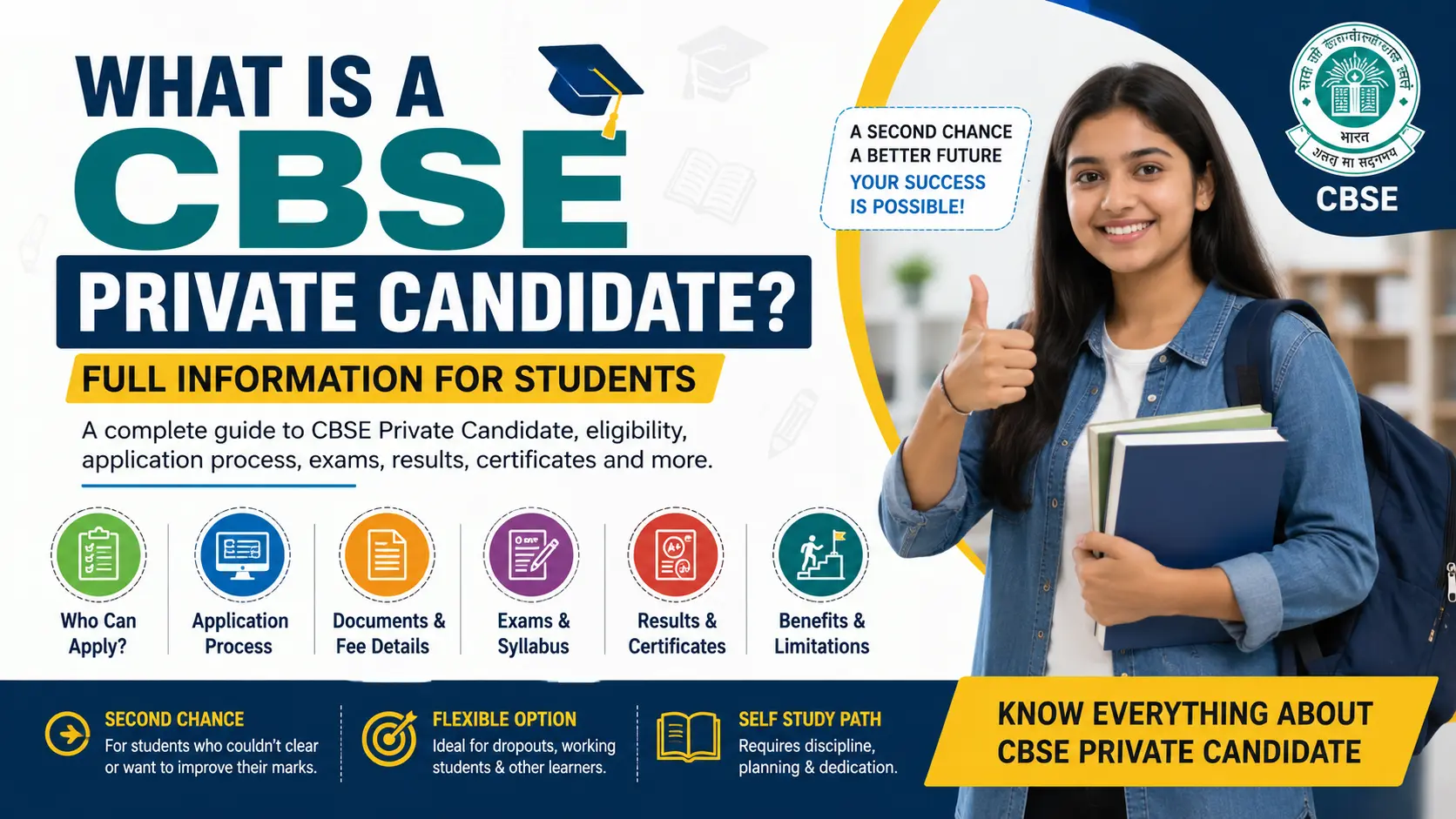
CBSE (Central Board of Secondary Education) is one of the main education boards in India that conducts Class 10 and Class 12 board examinations across affiliated schools. It follows a structured syllabus and standardized exams for students all over the country.
A private candidate is a student who appears for CBSE board exams without being regularly enrolled in a school during that academic year. They usually include students who have failed, want to improve their marks, or are appearing for compartment exams.
Students often search for this option because it provides a second chance to pass exams, improve scores, or continue studies even after leaving school or failing in regular attempts.
A CBSE private candidate refers to different categories of students who are allowed to appear in CBSE board examinations without being regular school students for that academic session. One major category includes students who are not enrolled in any regular school but still want to continue or complete their education through CBSE board exams. Another important group consists of students who have failed in previous board exams or received compartment, and they are given another opportunity to reappear and pass the exam as private candidates.
CBSE also allows students who want to improve their marks in one or more subjects to appear again as private candidates, helping them enhance their overall percentage for higher studies or career opportunities. In addition, there are some special permission cases, where CBSE permits certain candidates to appear privately due to specific conditions or requirements set by the board.
Overall, the private candidate system provides a flexible opportunity for students who are outside the regular schooling system or need a second chance to improve their academic results.
Students who can apply for the CBSE private candidate form are mainly those who are not continuing as regular school students in the current academic year but still want to appear in CBSE board examinations. This category includes students who have already appeared for CBSE exams earlier and now want to reappear, such as those who have failed, got compartment, or want to improve their marks.
For Class 10 and Class 12 students, the eligibility conditions are slightly different but follow the same basic rule that private candidates are mostly for re-appearing cases. Class 10 students who fail or get compartment in one or more subjects can apply again as private candidates. Similarly, Class 12 students who are in the same situation or want to improve their marks are also eligible. However, fresh students (first-time candidates) are generally not allowed to directly appear as private candidates without prior school enrollment or CBSE permission.
Regarding school enrollment status, the main requirement is that the student should not be a regular school candidate for that exam year. Either they must have completed schooling earlier, left school, or are appearing for re-exam/improvement. In most cases, valid previous CBSE roll number and result status are required to apply. The system is designed mainly for improvement, compartment, or re-appearing students rather than fresh admissions.
CBSE private candidates are divided into different categories based on their academic situation. The first category is fail candidates, which includes students who were unable to pass one or more subjects in their previous CBSE (Central Board of Secondary Education) board exams. These students are given another opportunity to reappear and clear their exams as private candidates.
The second category is compartment candidates, who have failed in only one or two subjects and are allowed to take a supplementary exam. If they do not clear the compartment in the regular attempt, they can also apply as private candidates to reappear.
The third category is improvement of marks candidates, which includes students who have already passed their board exams but want to improve their scores in one or more subjects. CBSE allows them to reappear as private candidates to enhance their academic performance for better opportunities in higher education or careers.
The fourth category is special category candidates, which includes students who are allowed by CBSE under specific conditions or special permissions. This may include unique cases approved by the board based on rules and eligibility criteria.
The CBSE private candidate application process is done completely online through the official CBSE website. Students who are eligible must visit the CBSE portal during the registration window and apply for the private candidate examination form. The process starts by selecting the correct category such as fail, compartment, or improvement, and then moving forward with the application.
In the form filling steps, students need to enter their personal details like name, date of birth, previous roll number, school details (if applicable), and subjects they want to appear in. After that, they must carefully choose their exam subjects and exam center preference (if asked). All details should be filled correctly because mistakes can affect admit card or results.
For document requirements, students usually need their previous CBSE mark sheet, admit card (if available), valid ID proof like Aadhaar card, passport-size photograph, and any other document requested by CBSE depending on the category. These documents are uploaded during the online application process.
The fee payment process is also done online. Students have to pay the examination fee through net banking, debit card, credit card, or UPI. The fee amount depends on the number of subjects selected and category type. After successful payment, a confirmation receipt is generated, which should be saved for future reference.
CBSE private candidates follow almost the same academic structure as regular students. They study the same syllabus as regular CBSE students, which means the subjects, topics, and chapters remain exactly the same as prescribed by CBSE for that academic year. There is no separate or easier syllabus for private candidates.
They also appear in the same question paper and marking scheme as regular candidates. This ensures fairness in the examination system, as both private and regular students are tested with identical question papers and evaluated using the same marking criteria. This means preparation level and difficulty remain the same for everyone.
The exam center allotment process is handled by CBSE after the application is submitted. Private candidates are assigned examination centers based on their location and availability of nearby schools approved by CBSE. The exam center details are mentioned on the admit card, which is released before the examination. Students must appear at the allotted center only; no changes are usually allowed after allocation.
The admit card for CBSE private candidates is issued online through the official CBSE website. Once the application process is completed and the exam form is successfully submitted, CBSE releases the admit card a few weeks before the examination. Students can download it by entering their login details or application number. In some cases, it may also be available through the respective regional CBSE office or exam center.
The exam center information is clearly mentioned on the admit card itself. CBSE assigns exam centers based on the student’s region and availability of schools approved for conducting board exams. Students are not allowed to choose their center freely, and once allotted, it generally cannot be changed. The exam center details include the school name, address, and reporting instructions.
Before the exam, students must follow several important instructions, such as carrying a printed admit card and valid ID proof to the exam center. They should reach the center on time, follow the exam schedule carefully, and obey all CBSE exam rules. Electronic devices like mobile phones, smart watches, and calculators (if not allowed) are strictly prohibited. Students must also follow proper exam discipline and seating arrangements as instructed by the invigilators.
The CBSE private candidate results are declared online on the official CBSE results portal, usually at the same time as regular board results or shortly after them. Students can check their results by entering their roll number, school number (if applicable), and admit card ID. The result shows subject-wise marks, grades, and overall pass/fail status. In some cases, CBSE may also send results to the regional offices or provide digital mark sheets that students can download and use for admission purposes.
Regarding the certificate difference, CBSE issues the same type of passing certificate to private candidates as it gives to regular students. The certificate is fully valid for higher studies and jobs. However, it may contain a small mention or indication that the candidate appeared as a private candidate or appeared under a specific category like improvement or compartment. Despite this mention, the value of the certificate remains the same, and it is accepted by colleges, universities, and employers just like a regular CBSE certificate.
The CBSE private candidate system provides a valuable second chance for students who were unable to perform well in their earlier board exams. It allows them to reappear in the examination without going back to a regular school system, giving them another opportunity to complete their education successfully.
It also serves as an opportunity to improve marks for students who have already passed but are not satisfied with their scores. By reappearing in selected subjects, they can increase their percentages, which helps in getting admission to better colleges, courses, or career options.
In addition, this system is a flexible option for dropouts or working students who cannot attend regular school due to personal, financial, or work-related reasons. It allows them to continue their studies at their own pace while still being part of the CBSE examination system, making education more accessible and inclusive.
The CBSE private candidate system comes with certain limitations and challenges that students must understand before applying. One major limitation is limited eligibility, as not all students are allowed to apply as private candidates. CBSE mainly permits only specific categories such as fail, compartment, improvement, or special cases, which means fresh students generally cannot directly register under this system.
Another challenge is no school support, because private candidates are not attached to any regular school during the exam year. This means they do not receive classroom teaching, regular guidance, or internal assessments from teachers, and they must manage everything on their own or through coaching and external help.
Finally, there is a strong self-study requirement, as students are fully responsible for their preparation. They need to follow the CBSE syllabus independently, create their own study plan, and practice regularly without school-based supervision. This makes discipline, consistency, and proper planning very important for success as a private candidate.
The CBSE private candidate system is an important option for students who are unable to continue as regular school candidates but still want to complete their education through board examinations. It provides a structured way for such students to appear in CBSE exams, whether they are reappearing after failing, improving their marks, or completing their studies after leaving school. This system ensures that education remains accessible even outside the traditional school environment.
At the same time, students are encouraged to use this option wisely and carefully. Since private candidates do not have regular classroom support, they must rely on strong self-study, discipline, and proper preparation strategies. It is important for students to understand the rules, eligibility, and challenges before applying, so they can make informed decisions and use this opportunity effectively to achieve their academic goals.
0 Response

Stay updated with the latest news, articles and updates directly into your box